What Is Peptide Purity and Why Does It Matter

When researchers purchase peptides for laboratory studies, one of the specifications they
often encounter is peptide purity.
But what does peptide purity actually mean? Why is it important? And does a higher purity
percentage always mean a better research material?
Understanding peptide purity can help researchers evaluate research materials more
effectively and interpret product documentation with greater confidence.
What Is Peptide Purity?
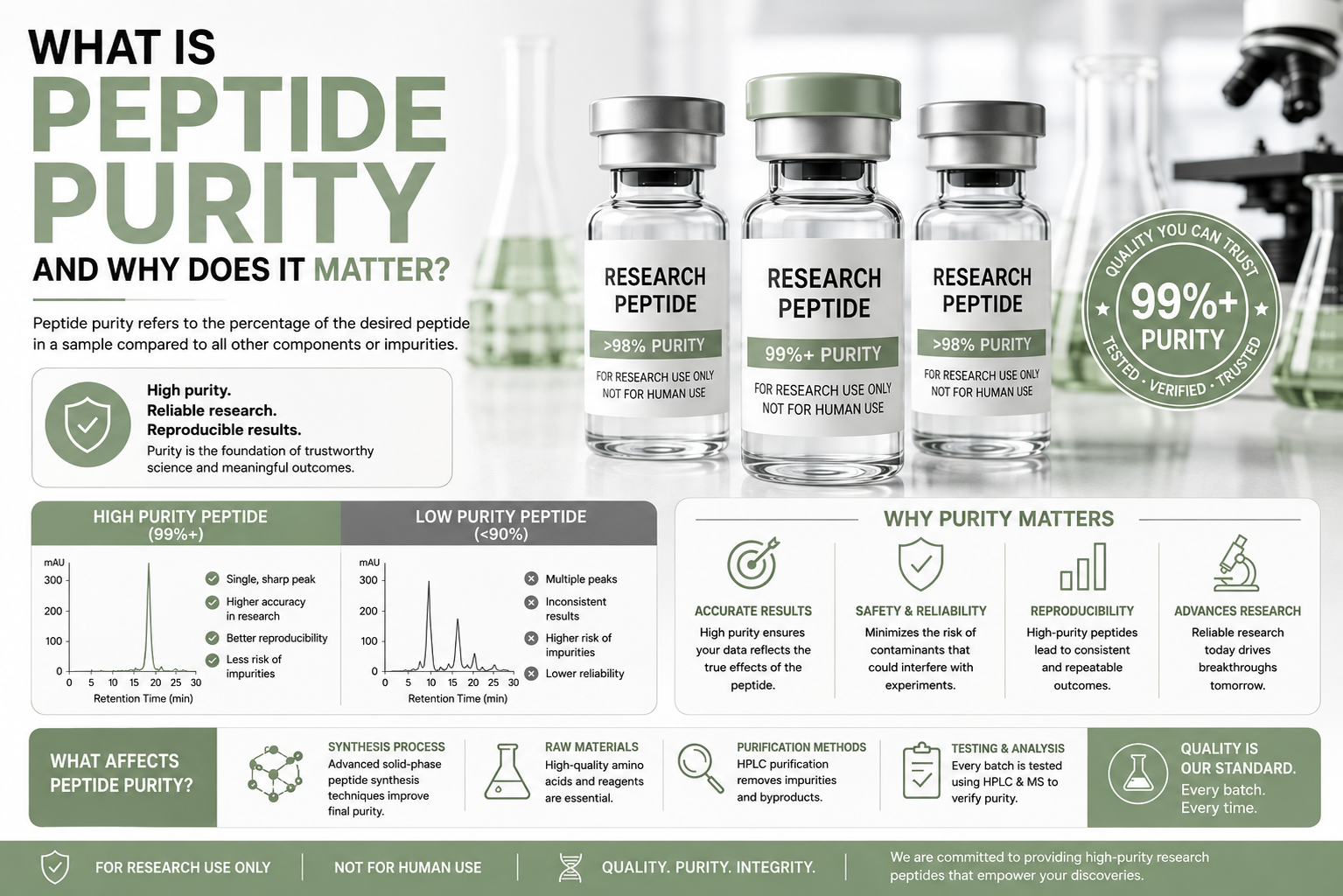
Peptide purity generally refers to the proportion of the target peptide in a sample compared
with other detectable components.
For example, a research peptide described as having 98% purity means that the analytical
method used to evaluate the sample reported approximately 98% of the measured material
as the target peptide under the conditions of that particular analysis.
The remaining portion may consist of other detectable substances, such as related peptide
sequences, synthesis-related impurities, degradation products, residual materials, or other
components.
The exact meaning of a reported purity percentage depends on the analytical method
used.
Why Does Peptide Purity Matter?
Purity can be important because researchers generally want to understand the composition
of the material being used in an experiment.
If a sample contains significant amounts of unwanted components, those components may
complicate the interpretation of experimental results.
For example, researchers studying a specific peptide may want to distinguish observations
associated with the target peptide from effects potentially associated with other substances
present in the sample.
The importance of purity therefore depends heavily on the specific research application.
How Is Peptide Purity Measured?Different analytical techniques can be used to characterize peptide samples.
One commonly used technique is High-Performance Liquid Chromatography (HPLC).
HPLC can separate components within a sample based on their chemical properties,
allowing researchers or analytical laboratories to evaluate the relative amount of the target
peptide compared with other detectable components.
Other analytical techniques can provide complementary information.
Depending on the research requirements, laboratories may use methods such as:
● HPLC
● Liquid chromatography
● Mass spectrometry
● Spectroscopy
● Other analytical characterization techniques
Each method provides different information, so researchers should understand what a
reported result actually represents.
What Is HPLC Purity?
HPLC purity is a measurement derived from chromatographic analysis.
During an HPLC analysis, different components of a sample can produce separate signals or
peaks. The relative area associated with the target peptide can be used to calculate a
reported purity value.
However, HPLC purity does not necessarily tell researchers everything about a sample.
For example, a chromatographic result may not by itself confirm every aspect of molecular
identity or detect every possible type of impurity.
This is why researchers may consider multiple analytical techniques when thorough
characterization is required.
What Is Mass Spectrometry Used For?
Mass spectrometry (MS) can provide information about the molecular mass of a
compound.
For peptide research, mass spectrometry can be useful for investigating whether the
measured molecular mass is consistent with the expected peptide.
Researchers may therefore consider identity information alongside purity measurements.
A purity result and an identity result answer different questions.● Purity: How much of the measured sample appears to correspond to the target
material?
● Identity: Does the material correspond to the expected peptide?
Both can be relevant depending on the research objective.
Does 99% Purity Mean a Peptide Is Better Than 95%?
Not necessarily.
A higher reported purity can be desirable for some experiments, but researchers should not
evaluate a peptide based solely on the percentage shown on a product page.
They should also consider:
● How purity was measured
● What analytical method was used
● Whether identity was evaluated
● Whether the result is batch-specific
● What other documentation is available
● Whether the material meets the requirements of the experiment
A reported 99% purity value obtained through one analytical approach cannot automatically
be compared directly with a 95% purity value obtained through a different methodology.
Why the Analytical Method Matters
The reported purity value is meaningful only within the context of the method used to
determine it.
Different analytical techniques have different capabilities, sensitivities, and limitations.
For this reason, researchers should look beyond a headline purity number and review the
available analytical documentation.
Questions researchers may ask include:
● What method was used?
● Was the analysis performed on the specific batch?
● What does the reported percentage represent?
● Is identity information available?
● Are analytical results documented?
Understanding the testing method can provide much more useful information than simply
comparing percentages.
What Is a Certificate of Analysis?A Certificate of Analysis (CoA) is a document that reports analytical testing associated
with a particular product or batch.
Depending on the supplier and the tests performed, a CoA may contain information such as:
● Product name
● Batch or lot number
● Reported purity
● Identity information
● Testing method
● Analytical results
● Date of testing
Researchers can use the CoA to help document and evaluate the research material they
receive.
A batch-specific CoA is generally more useful than a generic document that is not connected
to the specific material supplied.
What Can Cause Peptide Impurities?
Peptide synthesis and handling can involve multiple stages where related substances or
degradation products may occur.
Potential sources of impurities can include:
Incomplete Synthesis
During peptide synthesis, reactions may not always proceed perfectly. Related sequences
can potentially be generated during the process.
Side Reactions
Chemical reactions occurring alongside the intended synthesis pathway can contribute to
additional components in the final material.
Degradation
Peptides can change or degrade under certain environmental conditions.
Factors such as temperature, moisture, pH, light, and storage duration may influence
stability depending on the specific peptide.
Purification
Purification processes are used to separate the desired peptide from unwanted components.
The effectiveness of purification can influence the final composition of the material.Does Purity Affect Research Results?
It can.
The significance of purity depends on the type of experiment being performed.
In some research applications, relatively small amounts of related substances may be
important. In other experiments, the research design may tolerate a different level of
variation.
Researchers should therefore determine what purity and characterization requirements are
appropriate for their specific study rather than assuming that one purity specification is
universally necessary.
Purity vs. Quality: Are They the Same?
No.
Purity is one aspect of research material quality, but it is not the same thing as overall
quality.
Researchers may also consider:
● Identity
● Batch consistency
● Analytical testing
● Stability
● Storage conditions
● Documentation
● Traceability
● Supplier practices
A comprehensive evaluation considers the available information as a whole.
What Should Researchers Look for When Buying
Research Peptides?
When evaluating research peptide products, researchers may want to review:
1. Reported Purity
Check the stated purity and understand what the number represents.
2. Analytical Method
Determine whether the supplier identifies the method used to measure purity.3. Batch-Specific Testing
Whenever available, review documentation associated with the specific lot being purchased.
4. Identity Testing
Look for information that helps establish the identity of the material.
5. Certificate of Analysis
Review the available CoA and compare it with the product and batch information.
6. Storage Information
Follow the supplier’s storage recommendations and appropriate laboratory procedures.
7. Research Use Only Labeling
Ensure the material is clearly identified as Research Use Only and is not represented as a
product for human or veterinary use.
Frequently Asked Questions
What does peptide purity mean?
Peptide purity generally describes the proportion of the target peptide detected in a sample
according to a particular analytical method.
Is 99% peptide purity always better?
Not necessarily. Purity is important, but researchers should also consider the analytical
method, identity testing, batch documentation, and requirements of their specific experiment.
What is HPLC purity?
HPLC purity is a purity measurement obtained through high-performance liquid
chromatography, where components of a sample are separated and analyzed.
What is the difference between purity and identity?
Purity relates to the composition of the measured sample, while identity testing helps
determine whether the material corresponds to the expected peptide.
Why is a Certificate of Analysis important?
A CoA can provide analytical information about a particular batch and help researchers
document the material used in their experiments.Can peptide purity change over time?
The condition of a peptide can change under certain storage or environmental conditions.
Researchers should follow appropriate storage recommendations and laboratory
procedures.
Final Thoughts
Peptide purity is an important specification for researchers, but it should not be viewed as
the only measure of a research material’s quality.
A meaningful evaluation considers purity, identity, analytical methodology,
batch-specific documentation, stability, and traceability together.
When reviewing a research peptide, don’t simply ask, “What is the purity percentage?” Also
ask, “How was that purity measured, and what supporting documentation is available?”
Taking this broader approach can help researchers make more informed decisions when
selecting materials for laboratory research.
Research Use Only. Not for human or veterinary use.