
Peptide Terminology: A Complete Begineer’s Glossary

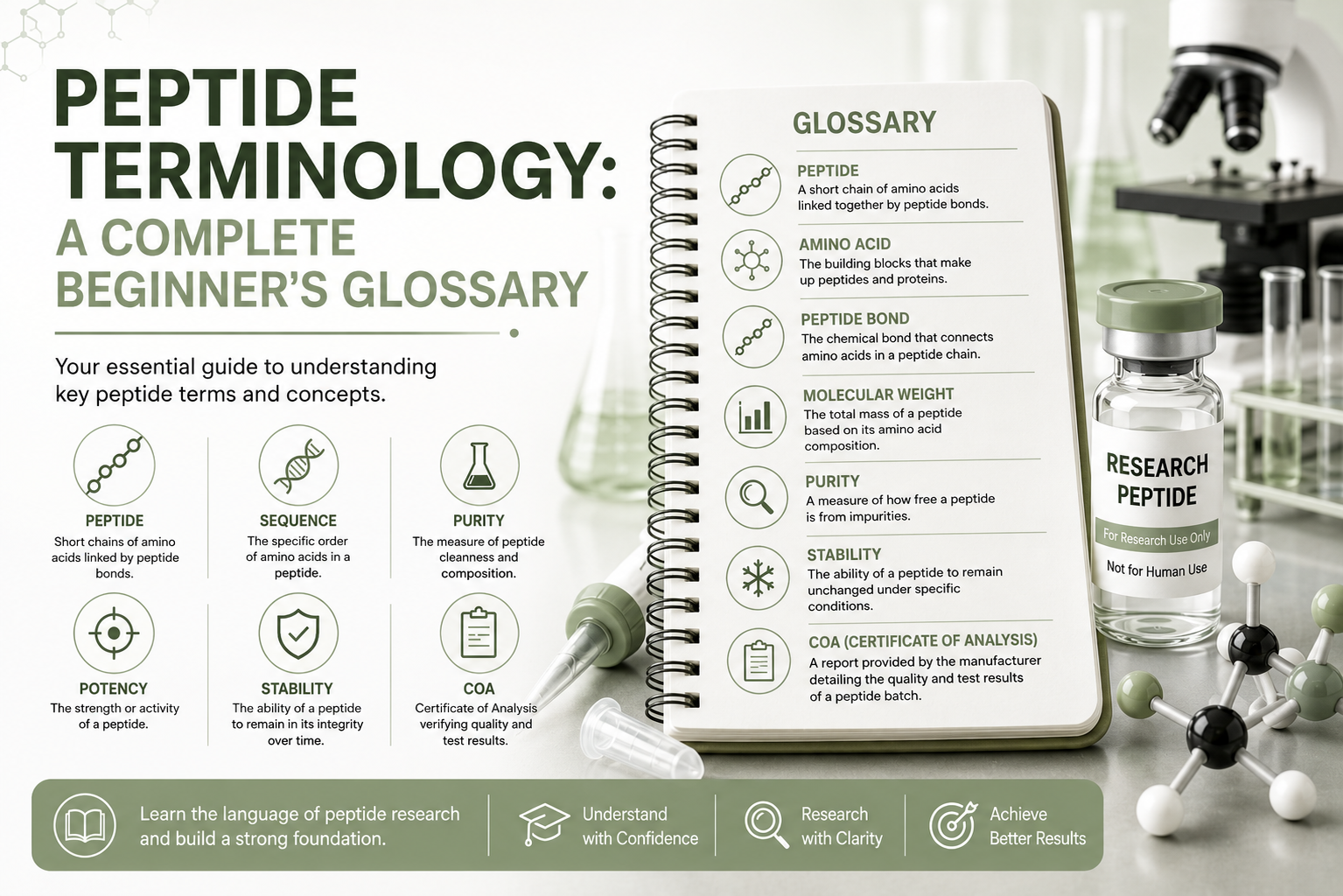
If you’re new to peptide research, scientific papers, product documentation, and laboratory
terminology can sometimes feel overwhelming.
Terms such as HPLC, purity, mass spectrometry, CoA, lyophilized, peptide sequence,
SPPS, and RUO appear frequently in peptide research. Understanding what these terms
mean can make it easier to read research information and evaluate laboratory materials.
This beginner-friendly glossary explains some of the most common terms used in peptide
research.
A
Amino Acid
An amino acid is one of the basic building blocks used to form peptides and proteins. Amino
acids are connected together through peptide bonds to create peptide chains.
Amino Acid Sequence
The amino acid sequence is the specific order of amino acids that make up a peptide.
The sequence is an important characteristic because changing the sequence can change
the properties and behavior of a peptide.
Analytical Testing
Analytical testing refers to laboratory methods used to characterize a research material.
Common analytical techniques used with peptides include:
● HPLC
● RP-HPLC
● Mass spectrometry
● LC-MS
● Other analytical methods
BBatch
A batch is a particular group of material produced during a manufacturing process.
Batch information helps researchers connect a research material with its associated
analytical documentation.
Batch Number
A batch number is an identifier assigned to a particular production batch.
Researchers can record batch numbers to improve traceability and research documentation.
Biological Activity
Biological activity describes the effect or interaction a substance may have within a
biological system.
Researchers may investigate biological activity as part of laboratory studies, but
research-use-only materials should not be represented as approved treatments.
C
Certificate of Analysis (CoA)
A Certificate of Analysis, commonly abbreviated as CoA, is a document containing
analytical information about a product or specific batch.
A peptide CoA may include:
● Product name
● Batch number
● Purity
● Testing method
● Identity information
● Testing date
● Other specifications
Chromatogram
A chromatogram is the graphical output generated by a chromatography analysis.
It typically displays peaks representing components detected during the analysis.
C-TerminusThe C-terminus is one end of a peptide chain.
It contains the carboxyl group and represents the end opposite the N-terminus.
D
Degradation
Degradation refers to chemical or structural changes that occur in a peptide over time.
Depending on the peptide, factors such as temperature, moisture, pH, light, and storage
conditions may influence degradation.
Daltons (Da)
A Dalton (Da) is a unit commonly used to express molecular mass.
Peptide molecular masses are frequently reported in Daltons.
F
Freeze-Dried
Freeze-dried is another way of describing a lyophilized material.
Freeze-drying removes water or another solvent under controlled conditions, leaving a dry
product.
H
HPLC
HPLC stands for High-Performance Liquid Chromatography.
It is a widely used analytical technique that separates components in a sample.
In peptide research, HPLC can be used to evaluate chromatographic purity and characterize
peptide samples.
HPLC PurityHPLC purity refers to a purity result obtained through an HPLC method.
For example, a peptide may be reported as having 99% HPLC purity.
The reported percentage should always be interpreted in the context of the specific
analytical method used.
I
Identity Testing
Identity testing is analytical testing used to help determine whether a material corresponds
to the expected peptide.
Techniques such as mass spectrometry can provide useful information about molecular
mass and identity.
Identity and purity are separate analytical concepts.
Impurity
An impurity is a component of a sample that is not the intended target peptide.
Potential impurities can originate from:
● Peptide synthesis
● Side reactions
● Incomplete reactions
● Purification
● Degradation
● Storage or handling
L
LC-MS
LC-MS stands for Liquid Chromatography-Mass Spectrometry.
It combines liquid chromatography with mass spectrometry.
Liquid chromatography separates components, while mass spectrometry provides
information related to their mass-to-charge ratios.
This combination can provide useful information for peptide characterization.Lyophilization
Lyophilization is the technical term for freeze-drying.
It is commonly used to remove water from certain laboratory materials under controlled
conditions.
Lyophilized Peptide
A lyophilized peptide is a peptide supplied in a freeze-dried form.
Researchers should follow the storage and handling instructions provided for the specific
research material.
M
Mass Spectrometry (MS)
Mass spectrometry, commonly abbreviated as MS, is an analytical technique that
measures mass-to-charge ratios of ions.
In peptide research, mass spectrometry can help researchers investigate:
● Molecular mass
● Peptide identity
● Molecular characteristics
● Related components
Molecular Mass
Molecular mass describes the mass of a molecule and is commonly expressed in Daltons
when discussing peptides.
Researchers may compare an experimentally measured molecular mass with the expected
value as part of peptide characterization.
Molecular Weight
Molecular weight is commonly used when discussing the mass of a molecule.
For peptides, molecular weight is often expressed in Daltons.
NN-Terminus
The N-terminus is one end of a peptide chain.
It contains the amino group and is conventionally considered the beginning of a peptide
sequence.
Peptide sequences are generally written from the N-terminus to the C-terminus.
P
Peptide
A peptide is a chain of amino acids connected through peptide bonds.
Peptides can vary considerably in length and structure and are studied across numerous
scientific disciplines.
Peptide Bond
A peptide bond is the chemical bond connecting amino acids within a peptide chain.
Peptide Chain
A peptide chain is a series of amino acids connected through peptide bonds.
The order of those amino acids forms the peptide’s sequence.
Peptide Modification
A peptide modification is a deliberate chemical change made to a peptide.
Researchers may study modified peptides to investigate how structural changes influence
properties such as stability or molecular interactions.
Peptide Purity
Peptide purity generally describes the proportion of the target peptide detected according to
a particular analytical method.
For example, a peptide may be reported as having 99% purity based on a specified HPLC
method.
Purity results should always be interpreted alongside the analytical methodology.
Peptide SequenceSee Amino Acid Sequence.
The peptide sequence identifies the order of amino acids within a peptide.
Peptide Synthesis
Peptide synthesis is the process of creating a peptide by connecting amino acids in a
defined sequence.
One commonly used method is solid-phase peptide synthesis.
Purification
Purification refers to processes used to separate the desired peptide from unwanted
components.
Purification may occur after peptide synthesis and before final analytical testing.
R
Reconstitution
Reconstitution refers to adding an appropriate solvent to a dry or lyophilized research
material to produce a solution.
The appropriate procedure depends on the specific research material and laboratory
protocol.
Research Use Only (RUO)
RUO stands for Research Use Only.
A research-use-only material is intended for laboratory research and scientific investigation.
RUO peptides are not intended for human or veterinary use.
Retention Time
Retention time is the amount of time required for a component to travel through a
chromatography system and reach the detector.
Retention time can provide useful analytical information when evaluating a sample.
RP-HPLC
RP-HPLC stands for Reverse-Phase High-Performance Liquid Chromatography.It is a commonly used form of HPLC for peptide analysis.
RP-HPLC separates compounds according to their interactions with the stationary and
mobile phases.
S
Solid-Phase Peptide Synthesis (SPPS)
SPPS stands for Solid-Phase Peptide Synthesis.
It is a widely used method for synthesizing peptides.
In simplified terms, amino acids are sequentially added to a growing peptide chain attached
to a solid support.
Stability
Stability describes how well a peptide maintains its chemical and physical characteristics
under specified conditions.
Researchers may investigate peptide stability under different:
● Temperatures
● pH conditions
● Storage periods
● Solvents
● Environmental conditions
Solubility
Solubility describes how readily a substance dissolves in a particular solvent under
specified conditions.
Peptides can have different solubility characteristics depending on their sequence and the
conditions being used.
T
Testing Method
A testing method is the analytical procedure used to evaluate a particular characteristic of a
research material.For peptide purity, the testing method could involve HPLC. Other characteristics may be
evaluated using techniques such as mass spectrometry.
Understanding the testing method is important when interpreting analytical results.
Traceability
Traceability is the ability to track a research material back to its specific product, batch, and
associated documentation.
Batch numbers, lot numbers, and Certificates of Analysis can help improve traceability.
U
USP
USP refers to the United States Pharmacopeia, an organization that publishes standards
and reference information related to medicines, ingredients, and other materials.
USP standards should not be confused with a general claim that a research peptide is a
pharmaceutical product.
V
Vial
A vial is a small container commonly used to hold laboratory materials.
Research peptides may be supplied in vials containing a specified quantity of material.
W
Water Content
Water content refers to the amount of water present in a material.
For some research applications, laboratories may evaluate water content because it can
affect the composition and characteristics of a sample.Quick Peptide Terminology Reference
Term
Simple Definition
Amino Acid
Building block of peptides and proteins
Amino Acid Sequence Order of amino acids in a peptide
Batch
Specific group of material produced together
Batch Number
Identifier for a production batch
CoA
Certificate of Analysis
Chromatogram
Graphical output from chromatography
C-Terminus
One end of a peptide chain
Degradation
Chemical or structural change over time
HPLC
High-Performance Liquid Chromatography
HPLC Purity
Purity determined using an HPLC method
Impurity
Non-target component in a sample
LC-MS
Liquid Chromatography-Mass Spectrometry
Lyophilized
Freeze-dried
Mass Spectrometry
Analytical technique providing mass-to-charge information
Molecular Mass
Mass of a molecule
N-Terminus
One end of a peptide chain
Peptide
Chain of amino acids
Peptide Bond
Bond connecting amino acids
Peptide Purity
Amount of target peptide detected by a specified method
Peptide Synthesis
Process of creating a peptide
Purification
Separation of the desired peptide from unwanted components
Reconstitution
Adding solvent to a dry material
Retention Time
Time required for a component to reach a chromatography
detector
RP-HPLC
Reverse-Phase HPLCRUO
Research Use Only
SPPS
Solid-Phase Peptide Synthesis
Stability
Ability to maintain characteristics under specified conditions
Traceability
Ability to track material to its batch and documentation
Frequently Asked Questions
What is the most important peptide terminology for beginners?
Some of the most useful terms to understand first are peptide, amino acid sequence,
purity, HPLC, mass spectrometry, CoA, batch number, RUO, lyophilized, and SPPS.
What does RUO mean?
RUO means Research Use Only. It indicates that the material is intended for laboratory
research and is not intended for human or veterinary use.
What does HPLC mean?
HPLC stands for High-Performance Liquid Chromatography. It is an analytical technique
commonly used to separate and analyze components in peptide samples.
What is a peptide CoA?
A Certificate of Analysis provides analytical information about a particular product or batch
and may include purity, identity, batch information, and testing methods.
What does lyophilized mean?
Lyophilized means freeze-dried. Some research peptides are supplied in this form.
What is peptide purity?
Peptide purity generally describes the proportion of the target peptide detected using a
specified analytical method.
What is the difference between purity and identity?
Purity relates to the composition of a measured sample, while identity testing helps
determine whether the material corresponds to the expected peptide.
Why are batch numbers important?Batch numbers allow researchers to connect the material they receive with specific analytical
documentation, improving traceability and research recordkeeping.
Final Thoughts
Peptide research has its own specialized vocabulary, but understanding the terminology
becomes much easier once the basic concepts are familiar.
Terms such as HPLC, purity, mass spectrometry, CoA, RUO, SPPS, lyophilization,
identity testing, and batch number appear frequently throughout peptide research and
laboratory documentation.
Whether you are reading scientific literature, reviewing a Certificate of Analysis, or
evaluating research materials, knowing these terms can help you better understand the
information available.
When evaluating research peptides, always consider the specific research purpose,
analytical methodology, supporting documentation, and intended use of the material.
Research Use Only. Not for human or veterinary use.