How Is Peptide Purity Tested?

When researchers purchase peptides for laboratory research, one of the most important
questions is often:
How is the peptide’s purity tested?
A purity percentage on a product page can provide useful information, but the number is only
meaningful when researchers understand how it was determined.
Peptide purity can be evaluated using analytical techniques that separate, identify, and
characterize the components of a sample. Among the most commonly discussed methods
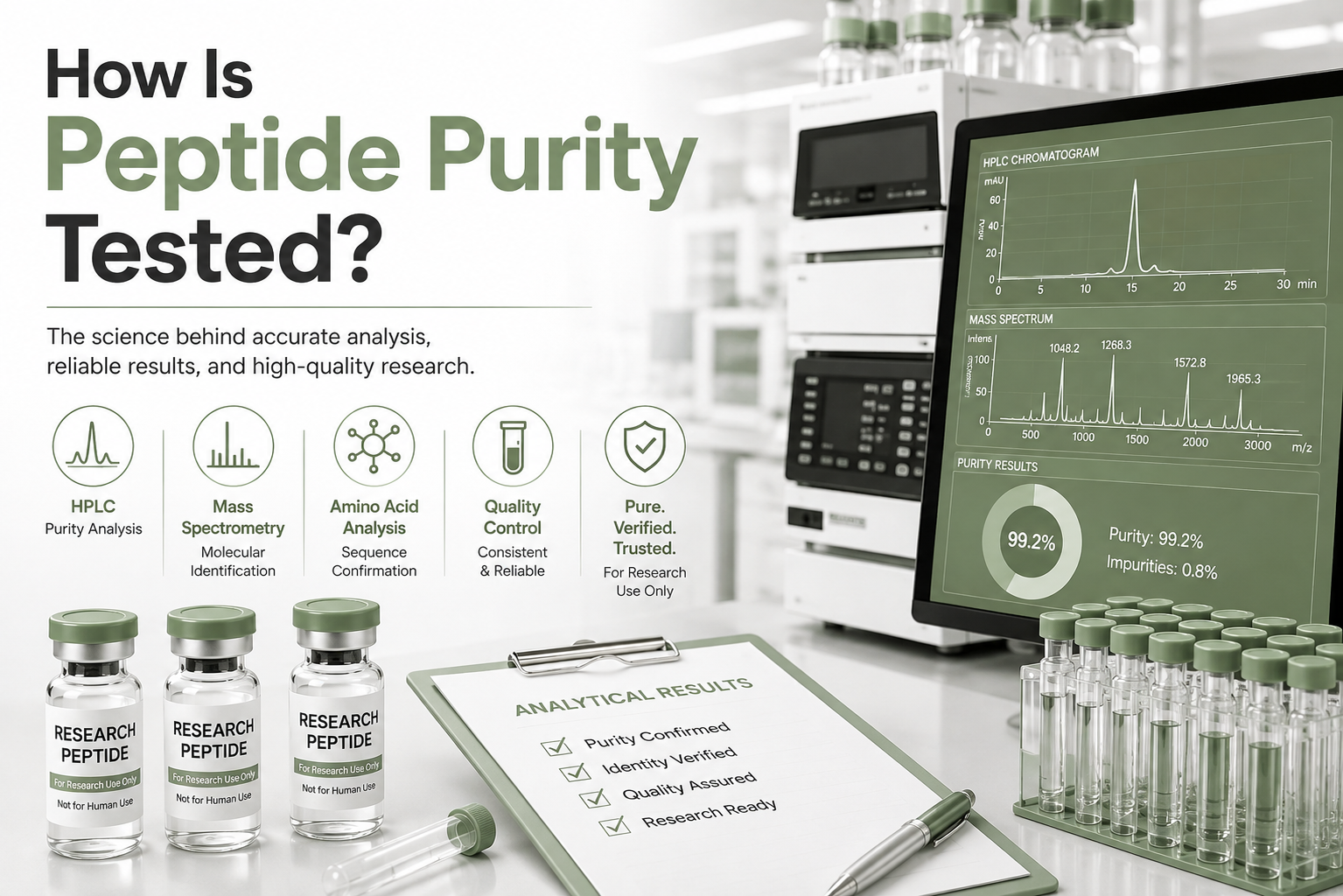
are High-Performance Liquid Chromatography (HPLC) and mass spectrometry (MS).
In this guide, we’ll explain how peptide purity testing works, what different analytical methods
can tell researchers, and how to evaluate a Certificate of Analysis (CoA).
What Does Peptide Purity Testing Measure?
Peptide purity testing is intended to determine how much of a sample corresponds to the
target peptide compared with other detectable components.
A peptide sample may contain the desired peptide along with small amounts of related
substances or other components resulting from synthesis, purification, storage, or
degradation.
Testing helps researchers and analytical laboratories characterize the material before it is
used in an experiment.
However, purity and identity are not exactly the same thing.
A purity test may indicate the relative amount of the target component detected by a
particular analytical method, while an identity test helps establish that the material is actually
the expected peptide.
For this reason, researchers may use multiple analytical techniques.
- HPLC: A Common Method for Peptide Purity
High-Performance Liquid Chromatography (HPLC) is one of the most commonly used
analytical techniques for evaluating peptide purity.
HPLC separates the different components in a sample as they pass through a specialized
chromatographic system.
The resulting analysis can show multiple peaks, with each peak representing a component
detected under the specific testing conditions.
The relative area associated with the target peptide can then be used to calculate a reported
purity percentage.
Why Is HPLC Useful?
HPLC can help researchers:
● Evaluate the chromatographic purity of a peptide
● Detect related components
● Compare batches
● Characterize peptide samples
● Monitor changes in a material over time
The exact capabilities depend on the HPLC method, column, mobile phase, detection
system, and other analytical conditions. - Reverse-Phase HPLC
Reverse-phase HPLC (RP-HPLC) is commonly used for peptide analysis.
In reverse-phase chromatography, separation is based largely on differences in interactions
between compounds and the stationary and mobile phases.
Different peptide-related components can therefore appear at different retention times.
The resulting chromatogram can provide information about the relative composition of the
sample.
Researchers should remember that an HPLC result is method-dependent. Different methods
can produce different analytical profiles. - Mass Spectrometry
Mass spectrometry (MS) is another important analytical technique used in peptide
characterization.
Rather than primarily measuring chromatographic separation, mass spectrometry provides
information about the mass-to-charge ratio of ions.
For peptide research, MS can help researchers investigate whether the measured molecular
mass is consistent with the expected peptide.
This makes MS particularly useful for identity and molecular characterization.
Purity vs. Identity
These concepts are related but different:
Purity asks:
“How much of the measured sample appears to be the target component?”
Identity asks:
“Does the measured material correspond to the expected peptide?”
Using complementary analytical methods can provide a more complete picture of a research
material. - LC-MS: Combining Separation and Mass Analysis
Liquid Chromatography-Mass Spectrometry (LC-MS) combines chromatographic
separation with mass spectrometric analysis.
This can provide researchers with information about both the chromatographic profile and
molecular mass of components detected in the sample.
Because it combines two analytical approaches, LC-MS can be particularly useful when
researchers need more detailed characterization.
Depending on the laboratory and research objective, LC-MS may be used to investigate:
● Peptide identity
● Molecular mass
● Related components
● Chromatographic behavior
● Sample composition - UV Detection in HPLC
Many HPLC systems use ultraviolet (UV) detection to monitor compounds as they pass
through the system.
The detector measures absorbance at selected wavelengths and produces a chromatogram.
The resulting peaks can be analyzed to estimate the relative amount of different detectable
components.
However, UV detection has limitations. Not every substance absorbs UV light equally, and
the measured response can depend on the compound and analytical conditions.
This is one reason researchers should interpret HPLC purity results within the context of the
specific method used. - How Is a Purity Percentage Calculated?
In a simplified chromatographic analysis, the area of the peak associated with the target
peptide can be compared with the total area of relevant detected peaks.
This produces a relative purity estimate under the conditions of the analytical method.
For example, if a chromatogram indicates that approximately 98% of the measured peak
area corresponds to the target peptide, the material may be reported as approximately 98%
chromatographic purity.
This does not necessarily mean that exactly 98% of every molecule in the physical sample
is the target peptide.
The reported result is specific to the analytical technique and conditions used. - Why Testing Methods Matter
Two suppliers could report different purity percentages for similar materials because they
use different analytical methods or testing conditions.
Researchers should therefore look for information about:
● Analytical technique
● Testing conditions
● Detection method
● Batch tested
● Date of analysis
● Reported results
A purity number without information about how it was obtained provides less context. - What Is a Certificate of Analysis?
A Certificate of Analysis (CoA) is documentation that reports analytical results associated
with a product or specific batch.
A peptide CoA may contain information such as:
● Product name
● Batch or lot number
● Test date
● Purity result
● Analytical method
● Identity information
● Other specifications
Researchers can use the CoA as part of their documentation when evaluating a research
material.
Batch-Specific vs. Generic CoAs
A batch-specific CoA identifies the particular lot that was tested.
This can provide greater traceability than a generic document that is not connected to the
specific batch supplied.
Researchers should compare the lot number on the product with the lot number shown on
the supporting documentation. - What Other Tests May Be Performed?
Purity is only one aspect of peptide characterization.
Depending on the research requirements, additional testing may be performed to evaluate:
● Molecular mass
● Identity
● Water content
● Residual solvents
● Counterions
● Elemental composition
● Physical characteristics
● Stability
Not every test is required for every research project.
The appropriate testing strategy depends on the peptide, intended research application,
formulation, and laboratory requirements. - How Researchers Can Evaluate a Peptide CoA
When reviewing a CoA, researchers can look for several important details.
Product Identification
Does the document clearly identify the peptide being tested?
Batch Number
Does the batch number match the material being purchased?
Testing Method
Does the document identify how purity or identity was evaluated?
Reported Results
Are the analytical results clearly presented?
Testing Date
When was the material tested?
Laboratory Information
Where appropriate, does the documentation identify the laboratory or testing facility
responsible for the analysis?
These details can help researchers evaluate the documentation supporting a research
material.
Does a Purity Test Guarantee Research Results?
No.
Analytical testing provides information about the characteristics of a material, but it does not guarantee the outcome of an experiment.
Experimental results can depend on many factors, including:
● Research design
● Experimental conditions
● Laboratory procedures
● Equipment
● Sample preparation
● Storage
● Measurement techniques
A well-characterized research material is only one component of a successful research
project.
Purity Testing vs. Pharmaceutical Quality Testing
It is also important not to confuse a peptide purity test with the broader quality requirements associated with pharmaceutical products.
A laboratory may perform an HPLC purity test on a research peptide, but that alone does not make the material a pharmaceutical product or establish that it is suitable for human use.
Pharmaceutical development involves broader manufacturing, quality, safety, regulatory, and
clinical requirements.
Research peptides should remain clearly identified as Research Use Only.
Common Questions About Peptide Purity Testing
What is the most common method for testing peptide purity?
HPLC is one of the most commonly used methods for evaluating chromatographic peptide
purity. Other methods, including mass spectrometry and LC-MS, can provide complementary
information.
Does HPLC prove peptide identity?
Not by itself. HPLC can provide important chromatographic information, but additional
analytical techniques may be used to evaluate molecular identity.
What does LC-MS tell researchers?
LC-MS combines liquid chromatography and mass spectrometry, allowing researchers to examine chromatographic separation alongside molecular mass information.
Is 99% HPLC purity the same as 99% total purity?
Not necessarily. The reported value is specific to the analytical method and conditions used.
Why is a batch-specific CoA useful?
A batch-specific CoA connects analytical results to a particular lot of material, improving traceability and documentation.
Can purity testing detect every impurity?
No analytical method detects every possible substance under every condition. Researchers should understand the capabilities and limitations of the method used.
Final Thoughts
Peptide purity testing is an important part of research material characterization.
HPLC can provide information about chromatographic purity, while mass spectrometry can help evaluate molecular mass and identity. Techniques such as LC-MS can combine these analytical approaches to provide additional information.
When evaluating a research peptide, researchers should look beyond a single purity
percentage. Understanding the testing method, reviewing batch-specific documentation, and considering complementary analytical data can provide a more complete picture of the material.
Research Use Only. Not for human or veterinary use